Wednesday, October 28, 2009

Tuesday, October 27, 2009

Mademoiselle Huretti


There MUST be a good story behind this print.

Object of the Week

This is definitely the prettiest nutmeg grater I've ever seen. Can you imagine anyone actually using it?

Here is the item record:

Nutmeg grater
1708-1709
Maker: Alexander Hudson
Origin: England, London
L: 2 5/8"; Diam (cover): 15/16"; Diam (base): 7/8'; L (grater): 2 1/4"
Silver

Label:
This nutmeg grater, like most late seventeenth- and early eighteenth-century examples, has a cylindrical case with pull-off cover containing a tubular grater. The case is conventionally engraved with medial bands of stylized leaf decoration and its cover with a tulip.

Provenance:
Garrard & Co. Ltd., London Acquired by CWF in 1968

Here is another grater with similar engravings. Why can't our modern everyday items also have beautiful decorative details?


Monday, October 26, 2009

"When Ancient Artifacts Become Political Pawns"

The NYT published a sad article about the complex forces behind campaigns for the repatriation of antiquities. While I'm generally sympathetic to the concerns of the original owners (particularly regarding items the Nazis took from Jewish citizens), the article traces the potential darker motivations behind some cases. Artifacts can function as potent cultural symbols representing a national identity. This trait leaves them vulnerable to exploitation during international power struggles. Officials in the country of origin can assume the moral high ground by demanding the return of an artifact while simultaneously using the resulting fight to accomplish their international relations agenda. Ironically, the specific artifacts mentioned in the article are still being used as cultural loot--this time by their countries of origin. How should we evaluate antiquities controversies when all parties involved are tainted? What criteria should be used in cases with ambiguous legal standing?

Thursday, October 22, 2009

Object of the Week

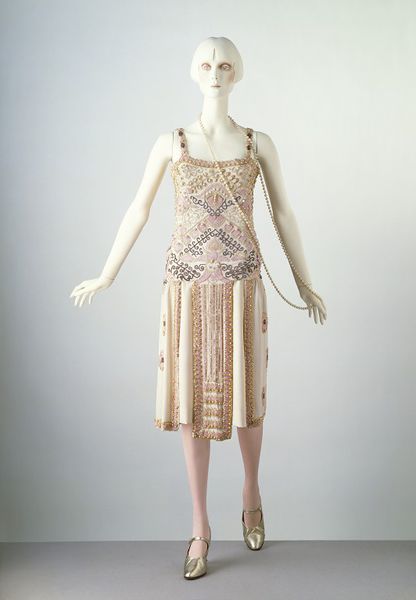
In honor of the newly launched V & A collections search I thought I'd begin by featuring one of the museum's dresses. Clothes are among the most intimate types of objects. They touch our skin, shield our bodies, and journey along with us through the trials in our daily lives. Old clothes provide a visceral link to the individuals who wore them. They preserve the stains and scents of use. Sometimes a garment even becomes a sculptural ghost when it retains the shape of the form that once filled it. The undeniably personal nature of clothing often leads to the survival of specific stories associated with the object. This dress is no exception.

Image from V&A website

The collections catalog describes the fascinating story behind the creation of the dress:

The dress was made and worn by the wife of Sir Hamo Thornycroft (1850-1926). He was a sculptor and designed it for her. They were both interested in the dress reform movement and conceived the dress in accordance with the movement's principles so it did not restrict the waist and arms.

It fits a natural, uncorsetted figure and is cut fairly full, with smocking at the back and front. The sleeves are elbow-length puffs, smocked and gathered, to reflect historical styles. The skirts consist of an overskirt, draped with tapes and gathered up, and an underskirt, mounted on a white cotton lining and tied back.

The sewing is not professional and the dress has been altered. The Liberty's material is a thin, probably Indian, washing silk of a type that seldom survives.